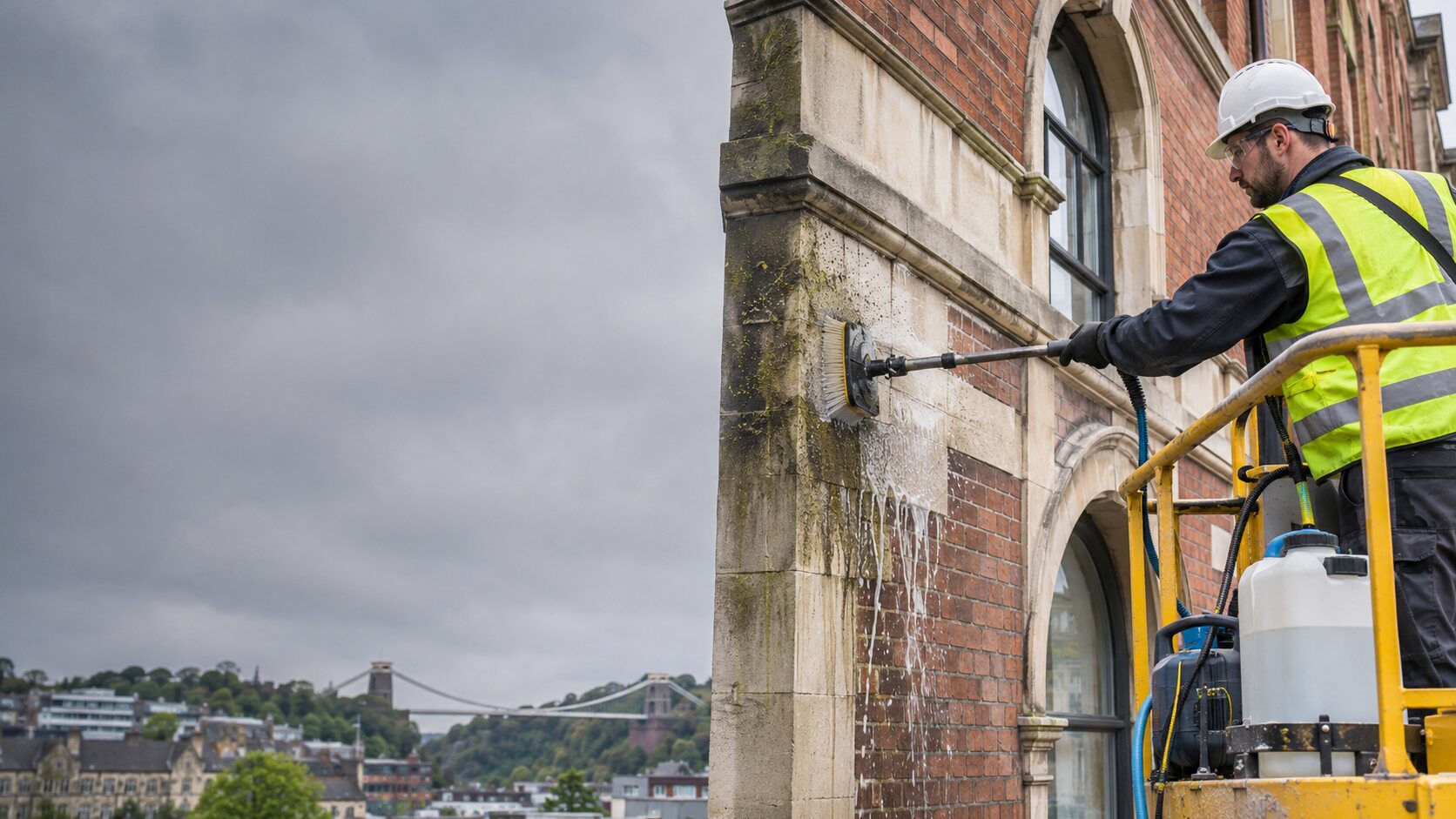
Facade cleaning in Bristol
Building exteriors around Bristol include painted render, brick, stone, cladding and glazed elements. A technique that improves one surface can mark another, so façade cleaning begins with material identification and a realistic goal. Nova Clean discusses exterior cleaning across Bristol, Filton, Frampton Cotterell, Winterbourne and Pill for homeowners, managing agents and businesses. We ask what deposits are present, whether there are loose finishes and how the public or occupants use the area below.
Match the method to the material
Atmospheric grime, algae, traffic deposits and staining from leaking gutters do not respond in the same way. Porous stone can retain discoloration, painted render may have weak areas, and old brickwork can suffer if joints are unstable. A small trial in a discreet area can help clarify the likely result. We discuss water use, runoff, neighbouring windows and planting before work begins. A clean cannot correct a defective gutter, cracked render or persistent moisture source, so those issues should be recorded separately.
Access and protection in a busy street
Work on a Bristol city centre frontage may require coordination with neighbouring occupiers and attention to pedestrian routes. A residential elevation in Clifton, Bedminster or St George can involve narrow side access, conservatories or gardens below. Larger premises around Filton may have loading bays and operational constraints. We define which elevations and details are included, how access will be achieved, what areas need protection and whether local permissions or a specialist access contractor must be arranged.
Set an achievable finish
Photographs are useful for an initial assessment, but age, prior coatings and hidden repairs can only be understood fully during closer inspection. We aim to remove suitable surface deposits without promising uniform colour on weathered materials. The quotation should distinguish cleaning from repainting, pointing, façade repair and window maintenance. Where a surface is too delicate for an ordinary method, we will explain the limitation rather than force a process that could cause damage.
For a quotation, describe the building height, approximate area, materials, stains and access. Contact Nova Clean Bristol at 0845 52 805 20 or
Begin with a survey of the elevation
A façade is not a single uniform surface. A Bristol terrace may have brick, stone dressings, painted timber and repaired render within one elevation. A modern commercial building can combine metal cladding, glass, sealants and signs. We ask for photographs of the full elevation and close-ups of deposits, joints and damaged areas. Height and approximate width matter, but so do window details, nearby planting, public access and the route for water to leave the work area. An initial photograph can guide a discussion; a closer inspection may be needed before a firm method or result can be stated.
The owner should explain whether the aim is to remove algae, traffic film, staining below a gutter, bird deposits or general dullness. Different causes respond differently. If a leak continues to mark the wall, cleaning alone will not keep it clean. A loose coating may lift when treated, revealing a need for repair. We discuss these possibilities before work, so the quotation is based on the actual material and condition rather than a promise that every exterior can be made uniformly bright.
Brickwork and older masonry
Brick varies in hardness and porosity, and mortar joints can be more vulnerable than the face of a brick. Older repairs may use a different material from the original wall. A forceful method may damage an already weak joint or alter the surface texture. We consider the type of soiling, the history of the façade and whether a small test is appropriate. A test can show how the wall responds and whether staining is embedded. The appearance of an older building is not necessarily improved by removing all traces of age.
Where a building has heritage significance or uncertain materials, specialist conservation advice may be needed before cleaning. The owner or managing agent should tell us about any listing, conservation restrictions or previous treatments. We would not treat a historic stone frontage as an ordinary modern wall. Repairs, pointing and moisture investigations may have to come before cleaning. A cautious specification protects both the fabric and the owner's expectations.
Render, painted surfaces and cladding
Render can show algae, rain streaks and marks from fixtures. Its surface may also be cracked, hollow or poorly bonded. Cleaning should not be used to disguise a repair issue. We ask about the age of the finish, any previous coating and whether water has entered the wall. Painted surfaces can chalk or peel when cleaned, particularly where the paint is already failing. A discreet test helps establish the likely effect. We can then describe whether a gentle clean is realistic or whether repainting and repair should be considered separately.
Metal or composite cladding introduces other questions: the finish, joints, fasteners, signs and manufacturer's care instructions. A product suitable for brick may be unsuitable for an anodised or coated panel. Water around seals and electrical signs needs control. We discuss which panels are included, how they will be accessed and whether the building operator needs to isolate equipment. An office frontage near Filton and a small shop in Bristol centre will need very different arrangements even if both are described as façade cleaning.
Control water and protect neighbouring areas
Water and loosened deposits can travel onto windows, pavements, planting and adjacent properties. The plan should identify where runoff will go and how pedestrians and vehicles will be managed. On a city centre street, temporary access arrangements may be necessary. A residential house with a narrow passage may have a neighbour's garden immediately below the work. We ask who controls those areas and whether permission or notice is needed. The client should know if moving furniture, vehicles or planters is part of their preparation.
A method cannot be judged solely by how quickly a wall appears clean. Excess water can enter defects, and overly aggressive pressure can damage finishes. We discuss a controlled approach suited to the material, including a test where appropriate and practical protection for adjacent surfaces. If the weather makes the method unsuitable, the date may need to move. The area should be reviewed after drying, since a wet wall can conceal residual streaks or differences in colour.
Access at height and public safety
An upper elevation may require a platform, scaffold or other suitable access. The safe choice depends on height, ground conditions, overhead services and the work area. A ladder is not a universal solution for sustained cleaning across a wall. We consider whether the public passes below and how the area can be controlled. In a block of flats, residents may need to keep windows closed during work and avoid balconies. In a business, staff may need an alternate entrance. These arrangements should be agreed with the appropriate manager before the visit.
Access cost can be a significant part of exterior work. A quotation should make clear whether equipment hire, permits and specialist operators are included or separate. If a trial identifies a better method, the access plan may need adjustment. It is useful to decide who will obtain permissions and who will inform neighbours. A well-defined arrangement is safer and avoids a crew arriving to find that the proposed route is blocked.
Stains that need more than cleaning
Black streaks below a leaking gutter may reappear until the gutter is repaired. Rust from a fixing can leave a stain that remains after surface dirt is removed. Organic growth can be linked to persistent shade or moisture. Efflorescence and discoloration from within masonry may call for investigation rather than repeated washing. We can describe what appears removable and what may remain uncertain until a test. The owner can then decide whether repairs, painting or other maintenance are needed.
Graffiti, heavy bird fouling and fire-related deposits are distinct problems that may require their own scope. If several kinds of contamination are present, identify them separately. A single product or process rarely suits every mark and every material. Where the wall has mixed surfaces, work may be phased or limited to sections that can be treated safely. This clarity is more useful than a blanket claim to restore the entire façade to an original colour.
Bristol buildings and local conditions
Clifton and Redland include older elevations with decorative details and limited side access. Bedminster and St George have a mix of terraces, shops and newer developments. Around the Floating Harbour and central routes, traffic film and exposed frontages can combine with public access constraints. Filton has commercial premises where loading and operating hours matter. Frampton Cotterell, Winterbourne and Pill bring houses and local businesses with different ground space and neighbouring arrangements. We ask about the particular building rather than assuming a standard method for a postcode.
A property manager may be commissioning work for several elevations or a shared courtyard. They should identify the ownership of each surface, any lease restrictions and who will approve the result. A homeowner can explain whether the rear and side walls are included and if a conservatory prevents access. A business can note signs, external lights and deliveries. These details shape the method and the time needed.
Building a useful quotation
Describe the façade materials, approximate dimensions, number of elevations, deposits, access and any known damage. Photographs from ground level should include a full view and a few details. Tell us about previous cleaning, coatings and planned repairs. The proposal can identify test areas, method assumptions, protection, runoff handling and realistic exclusions. If the building is too delicate or an unsafe area cannot be reached, we will discuss that before work rather than include it under an ambiguous promise.
Ask what the finished wall may look like after drying and whether a follow-up inspection is included. Old brick and stone can retain variation, and a repaired section may stand out more clearly after dirt is removed. The result should be judged against the agreed test and scope, not against an imaginary new surface. A written record of limitations can help owners make later maintenance decisions.
Aftercare and maintenance
Once an elevation is cleaned, inspect gutters, seals, fixtures and nearby drainage if they have contributed to staining. Ongoing shade and moisture may allow organic growth to return. Cleaning frequency should be based on the building and its environment rather than a fixed universal schedule. A maintenance team can keep small areas of build-up from becoming a larger task, provided it uses methods compatible with the surface. Any repair recommended during the work should be assessed by a suitable specialist.
Contact Nova Clean Bristol on 0845 52 805 20 or
Decisions before a listed or sensitive building is treated
When a façade has historic detailing, the owner should establish what approvals and specialist advice apply to the proposed work. Cleaning can change the appearance of masonry permanently, even if no obvious damage is visible while it is wet. A conservation professional may need to review the material, prior repairs and a test specification. The cleaning contractor should work to the agreed limits and stop if the fabric responds unexpectedly. The objective is to care for the building, not to remove every trace of weathering regardless of its effect.
For a modern building, manufacturer guidance may play a similar role. Coated panels, sealants and glazing systems can have care instructions that restrict products and pressure. Ask the building manager for those documents if available. If the façade incorporates signs, cameras or lighting, identify who can make them safe and whether they must remain operational. These discussions help define a method before equipment is booked and reduce the chance of a late change to the programme.
Where the owner is considering repainting, cleaning may be preparatory work rather than the final finish. Agree whether the cleaning is intended to remove surface soil for assessment or to prepare a coating, and let the decorator specify any further preparation. These are different outcomes. A quotation should not imply that a cleaned wall is automatically ready for every coating. Recording the intended next step helps everyone judge the result against the correct purpose.