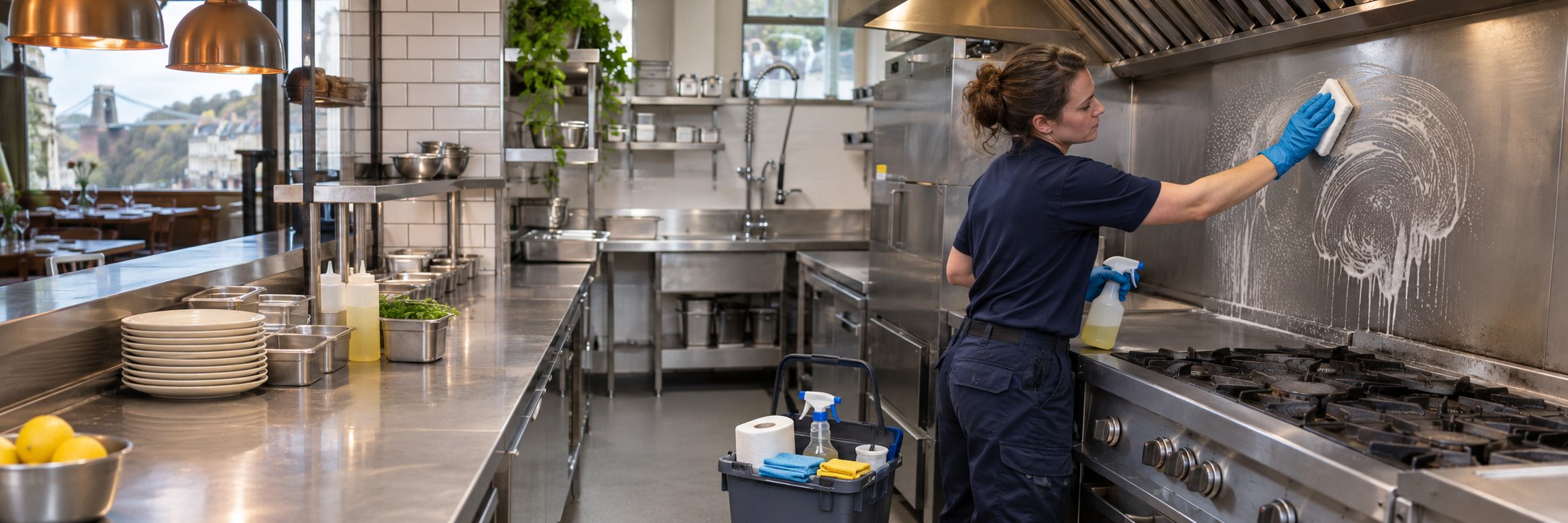
Commercial kitchen deep cleaning in Bristol
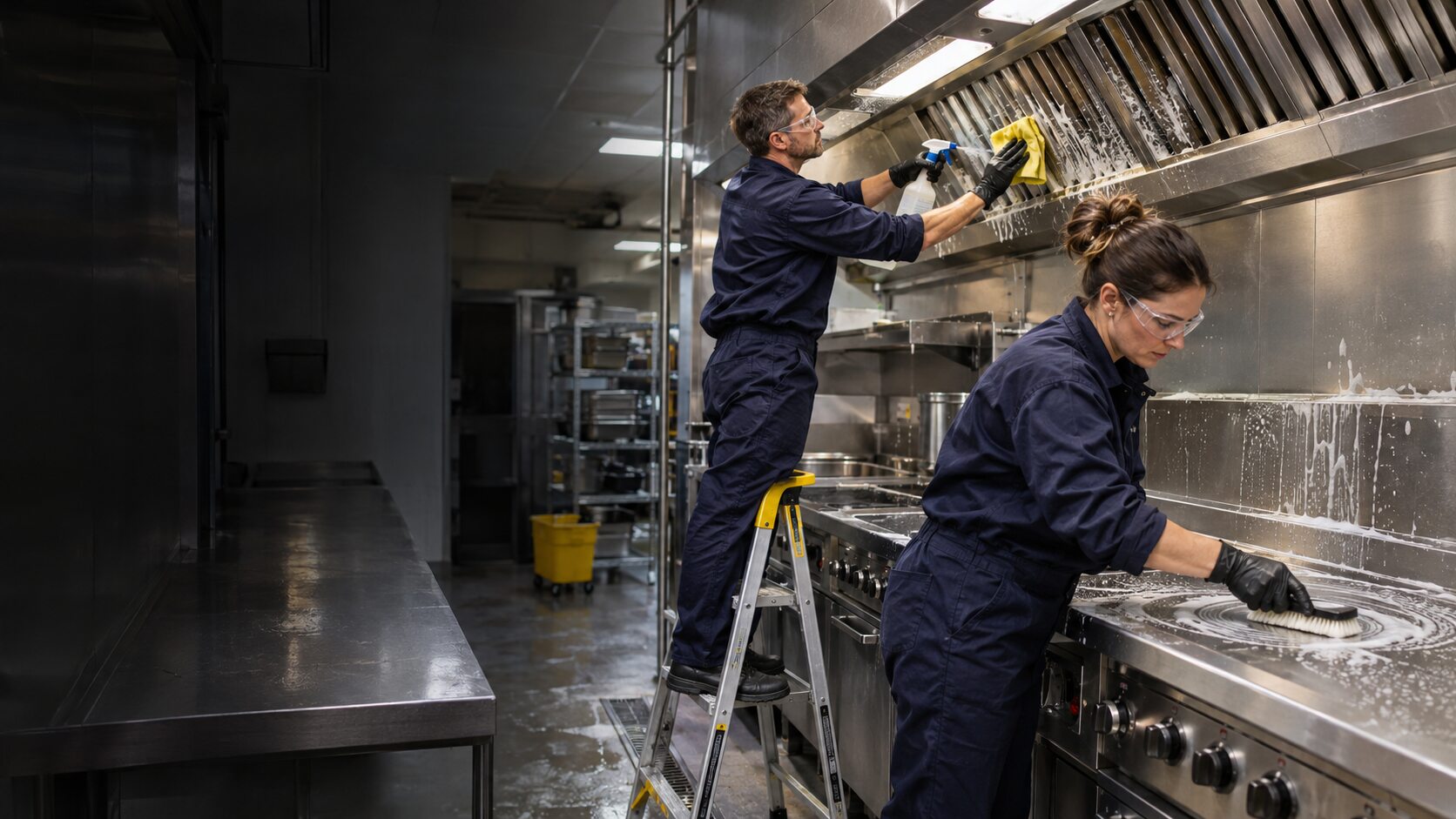
For a Bristol restaurant, the cleaning window starts when the last order leaves the pass and ends before the first prep team returns. A café that opens early may be able to release the oven line overnight but still need the cold-preparation bench for the morning delivery. Nova Clean works from an equipment list and the kitchen manager’s service times to agree accessible grease removal, floor edges and the areas staff will inspect before reopening.
Define equipment and exclusions before the shift
List each item by its position on the line. The face and accessible filters of a canopy are different from the inside of the extraction duct, and a quotation should say which is included. Where equipment is being replaced, coordinate a separate post-refit clean for the room once the fitters finish. Identify the manager who will receive the handover and update the kitchen’s regular cleaning schedule.
Cooking lines, splashbacks, floors, wall junctions and accessible exteriors of appliances can carry different grease loads. We ask for an equipment list, photographs and information about power or gas isolation. Staff may need to empty cupboards and fridges, move stock and protect food contact items. Where heavy equipment cannot be moved safely, the quotation should say so. Ventilation ductwork, fire suppression systems and specialist appliance servicing should be identified as separate work if they are not included. A vague promise to clean the whole kitchen is unlikely to be useful to an operator who must reopen on time.
Methods suited to surfaces and food operations
Degreasing requires attention to dwell time, rinsing, material compatibility and control of wastewater. Stainless steel, painted panels, grouting and older floor finishes respond differently to products and mechanical action. We plan work from higher surfaces to lower areas where practical, allowing time for accessible equipment and floors to dry before the operator returns. The cleaning team should know which areas are restricted, how waste leaves the premises and who will inspect the result. We do not describe cleaning as certification of a kitchen or a substitute for the operator's food safety procedures.
Local scheduling across Greater Bristol
City centre premises can have limited loading and waste access, while a kitchen in Filton may need coordination around staff shifts or deliveries. In Clifton, Bedminster or St George, neighbouring occupiers and noise-sensitive hours can affect the sequence. We discuss these constraints before proposing a date. The request should specify kitchen size, services required, current grease condition, photographs, preferred closure window and any equipment that must remain connected.
Contact 0845 52 805 20 or
How to prepare a kitchen for a planned deep clean
A kitchen can only be cleaned thoroughly when the operator has decided what remains in use and what can be moved. Before the appointment, identify the areas included in the agreed scope and make a list of appliances that need attention. Food, utensils and open ingredients should be removed or protected according to the business's own procedures. Staff should know when preparation stops, who isolates equipment and who can approve the return to use. If a fryer, combi oven or refrigeration unit needs specialist servicing, arrange that separately. A cleaning team should not be asked to disconnect equipment without the agreed competence and authority.
Photographs should show the cooking line, extraction canopy, floors, wall junctions and any hard-to-reach spaces. A few close-ups of grease are less useful than views that show equipment layout and access. Tell us whether the kitchen is on an upper floor, whether there is a loading entrance, where waste can be handled and whether hot water is available. If staff have already started a deep clean, explain which areas are complete so the remaining work can be defined. This preparation helps a quotation reflect the real condition rather than a generic cost per square metre.
Grease around cooking equipment
Grease can accumulate on the surfaces behind a cooking line, beneath accessible equipment and around joints where daily wiping is difficult. The deposits may vary from soft residue to hardened layers mixed with dust. The approach should account for dwell time, mechanical action, safe rinsing and the materials beneath. Stainless steel, painted panels, plastic fittings and older sealants can react differently. We may need a discreet test before treating a visible finish. The operator should point out loose panels, damaged electrical housings and any areas that must not receive water.
We distinguish the accessible exterior of a canopy from internal extraction ductwork and fan systems. These are not interchangeable scopes. A quotation should identify whether the canopy surfaces, filters and reachable surrounding areas are included, and whether a specialist duct clean is required separately. It should also state whether appliances are moved, who moves them and who reinstates them. An assumption that everything behind a heavy cooking line will be reached may lead to disappointment if moving it would compromise gas, electricity or a sealed floor junction.
Floors, drains and hard-to-reach junctions
Kitchen floors often combine grease, tracked soil and repeated wet cleaning. Grout, joints and edges around equipment can hold build-up. The type of floor, its slip resistance and the condition of any coating influence the method. We discuss the use of suitable tools, collection of dirty solution and time for drying. Water should not simply be pushed into a drain without considering what it carries and whether that route is appropriate. A damaged floor can remain difficult to clean even after a careful intervention; repairs and ongoing maintenance may be needed.
A floor plan helps identify areas that must stay open as a route or cannot be cleaned while deliveries arrive. In a compact café kitchen near Bristol's centre, a short closure may leave little room for staging equipment. In a larger catering unit in Filton, several sections may be tackled in sequence. We can describe a practical order of work and the likely time needed for staff to inspect the result. Operators should build in a buffer before food preparation resumes, particularly when equipment and floor edges need to dry.
Food contact areas and the operator's responsibilities
A deep clean is part of a broader hygiene system, not a replacement for it. The operator remains responsible for food safety procedures, training, monitoring and appropriate sanitising before production. We can agree how cleaned surfaces will be handed back and which areas the business will check and prepare for use. The scope should distinguish removal of grease and soil from any specifically agreed disinfection. Products and rinsing need to suit the material and intended use. Claims of complete sterility or guaranteed inspection outcomes would be misleading, so we focus on the defined work and observable condition.
It is helpful to nominate one person who can answer questions during the visit. That person should know which equipment is isolated, where supplies are stored and what must remain untouched. If the operator cannot attend, written instructions and a key handover should be agreed beforehand. In a shared building, access to water, waste routes and alarm systems may depend on a landlord or managing agent. These practical arrangements can affect the price and schedule as much as the size of the kitchen.
Scheduling around service, staff and neighbours
A restaurant may prefer a night or early morning intervention, while a school or workplace kitchen can have a planned closure. We discuss opening times and any restrictions on noise, loading and ventilation. In a mixed-use building in Clifton or Bedminster, neighbouring residents may be affected by equipment movement. A kitchen in Winterbourne or Pill may have easier parking but different access to waste services. We avoid promising an exact duration without knowing the deposits, the appliance arrangement and the preparation completed by the operator.
When several trades are involved, sequencing matters. A refrigeration engineer should complete a repair before the area is cleaned for return to use. A building contractor may need to finish dusty work before the final clean. A pest management provider may need access to inspect behind equipment. The business can coordinate those visits so cleaning does not have to be repeated. We can discuss whether a first intensive clean and a later maintenance clean would be more suitable than trying to complete every task while the kitchen remains fully operational.
What to include in a clear quotation
A detailed proposal should name the rooms and zones, accessible equipment exteriors, floors and wall surfaces included. It should describe the assumed condition, the preparation required from the operator, the access window and any likely exclusions. It can also note whether the business supplies electricity and water and how collected waste will be handled. If the scope depends on moving equipment, that condition must be explicit. A photograph may not show a concealed void, so variations discovered after safe access should be discussed before additional work proceeds.
Ask whether the quote covers canopy interiors, filters, ducts, ovens, drains, cold rooms and storage areas. These terms can mean different things to different suppliers. It is better to list the exact components than rely on a broad phrase such as whole kitchen. Also ask when the business can inspect the result, who signs off access and what should be done if a surface proves damaged or unsuitable for the planned method. The objective is a usable description of work rather than an unrealistic promise of a perfect finish.
What the kitchen manager can check before the next service
Once the space is handed back, the operator can review cleaned areas, reinstate equipment according to its procedures and complete any food contact sanitising required by its own system. A fresh daily and periodic cleaning schedule can help prevent rapid build-up. Where the intervention revealed cracked grout, failing seals or a broken appliance panel, record those issues for repair. Repeated grease deposits in an unexpected place may signal a maintenance or ventilation problem. Cleaning alone will not remove that underlying cause.
Photographs of the treated areas can support a handover where appropriate, but they should not capture staff, customers or confidential business information unnecessarily. The client can keep its own maintenance records and decide whether another specialist visit is needed. We can discuss which areas were inaccessible and what preparation would be required to address them later. A commercial kitchen deep clean is most valuable when its limits are understood and its findings are acted upon.
Greater Bristol enquiries
We discuss work for restaurants and food businesses in Bristol city centre, Clifton, Redland, Bedminster, St George and surrounding locations, as well as Filton, Frampton Cotterell, Winterbourne and Pill. Each kitchen has a different layout, opening pattern and level of build-up. Send the address, approximate floor area, equipment list, photographs, preferred closure period and the name of the person who can authorise access. Explain any planned inspection or reopening deadline, while allowing enough time for a realistic assessment.
Call 0845 52 805 20 or email
Different premises need different priorities
A small café with one cooking line may be most concerned with the rear of equipment and floor edges. A larger restaurant can need a sequence that keeps part of the building accessible for stock or staff. A production kitchen may have stricter handover arrangements and equipment that cannot be stopped at short notice. We ask which spaces have the heaviest build-up and which results are essential before reopening. This lets the operator prioritise work within a realistic closure window and understand what can be completed in a later visit if access is limited.
We also ask whether the kitchen has been unused for a prolonged period. A closed property may present different issues from an active one, including stale stock, water leaks or damaged finishes. Those problems should be identified before ordinary degreasing begins. In every setting, a responsible person should confirm the boundaries of the work and be available to discuss an unexpected condition. Clear instructions reduce delays and allow the team to avoid handling belongings or equipment outside the agreed scope.
Where a business needs photographs for its records, agree the areas to document in advance and keep the images limited to the work completed. A final walk-through can then compare the stated scope with accessible cleaned surfaces and list repairs or additional work separately. This makes the handover useful for the manager on duty, for the owner and for anyone planning the next periodic clean. It also avoids treating a short visible inspection as a certification of every concealed part of the kitchen.